How to Create Talking Head Reels for Business (Step-by-Step Guide That Saves Time)
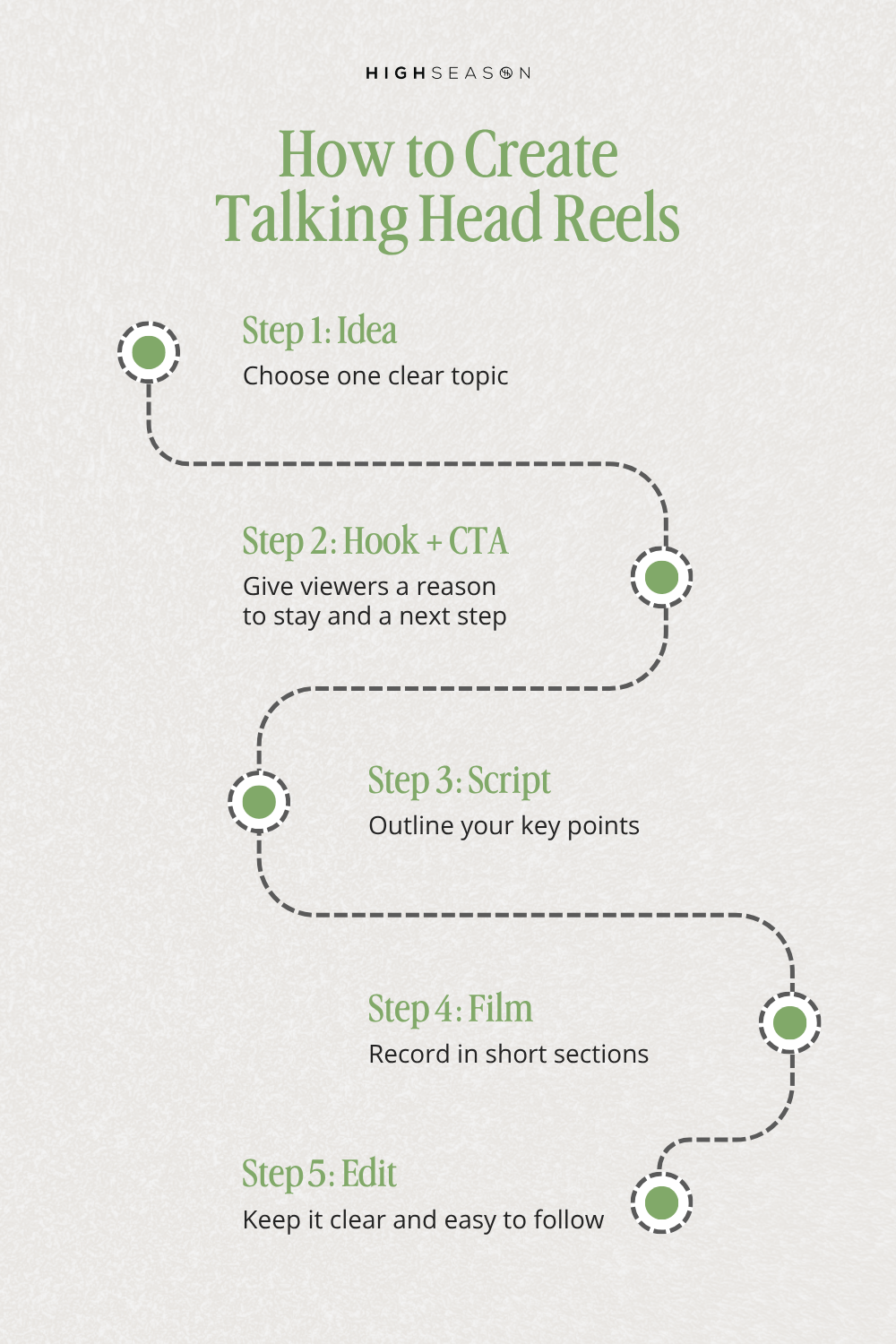
If you want to create talking head Reels for your business, follow a simple system: idea → script → film → edit.
That’s the process.
You don’t need complicated editing or hours of production.
What actually makes these Reels work is:
a clear idea
a strong hook
and a structure you can repeat
Talking head Reels are one of the fastest ways to build trust and connect with your audience — because people get to see and hear you.
What’s usually getting in the way
Most business owners don’t struggle with effort.
They’re trying.
They open the app.
They think about what to say.
They start recording… and stop.
Or they record something and feel unsure about posting it.
It’s not a motivation problem.
It’s not even a confidence problem most of the time.
It’s a structure problem.
When you don’t know how to:
organize your thoughts
film without pressure
or turn clips into a finished video
everything starts to feel heavier than it needs to be.
What is a talking head Reel (and why it works)
A talking head Reel is a short-form video where you speak directly to the camera.
That’s it.
Definition:
Talking Head Reel
→ A short video where you speak directly to your audience to share an idea, insight, or instruction.
This format works across almost every type of business:
service providers
product-based brands
local businesses
educators
Because it helps people understand:
how you think
how you explain things
what it would feel like to work with you
That’s where trust starts.
And trust is what turns content into opportunity.
The simple system: How to create talking head Reels for business
Let me walk you through this in a way you can actually follow and repeat.
Step 1 — Start with one clear idea
Every Reel should focus on one idea.
This is where most videos fall apart.
When the idea isn’t clear, the video feels harder to create — and harder to watch.
A simple way to find ideas:
questions your clients ask
things you explain often
common mistakes you see
Keep a running list so you’re not starting from zero each time.
If you’re clear on what to say but hesitate when it’s time to record, this will help.
Our On-Camera Confidence Guide gives you a simple structure to follow so filming feels easier every time.
Inside, you’ll find:
a pre-filming checklist
video frameworks you can reuse
and small shifts that make a big difference in how your content comes across
The goal is to make showing up on camera feel like part of your process — not something you avoid.
Grab your free copy of the guide here.
Step 2 — Write your hook and CTA first
Before you script anything else, write:
your hook
your CTA
Your hook gives someone a reason to stay.
You have a few seconds to make that clear.
Examples:
“If showing up on camera feels awkward, try this”
“Service providers — this is what to post this week”
Your CTA gives your content direction.
It could be:
follow for more
save this
download a guide
When these two pieces are clear, everything else becomes easier to build.
Step 3 — Turn your idea into a simple script or outline
You don’t need anything complicated here.
A simple structure works well:
Hook
1–2 key points
CTA
You can:
write it word for word
or use bullet points
If you prefer to talk things out naturally, an outline works well.
If you want more control over your message, a full script can help.
The important part is clarity — not perfection.
Step 4 — Film your Reel (without the pressure)
This is where most people get stuck.
It often comes from trying to record everything in one take.
A simpler way to approach this:
film one or two lines at a time
pause between sections
move through your script step by step
You can piece everything together later.
This takes a lot of pressure off and makes filming feel more manageable.
For your setup:
your phone is enough
natural light works well
a simple tripod helps keep things steady
You don’t need a full production setup to create strong content.
Step 5 — Edit your Reel to keep attention
Editing doesn’t need to be complicated.
The goal is simple:
Keep people watching.
Start by:
cutting mistakes and long pauses
tightening your clips
Then you can layer in:
small zooms
text on screen
simple visuals
These help reset attention and make your message easier to follow.
If you prefer simple content, your edit can stay minimal.
If you enjoy adding more detail, you can build in visuals over time.
If you want to see this step-by-step
If you want a full visual walkthrough of scripting, filming, and editing:
👉 https://youtu.be/HSqc7RdLW90
This will walk you through the exact process so you can follow along in real time.
What actually makes a talking head Reel work
It’s easy to focus on editing.
But what matters most is:
clarity of the idea
strength of the hook
how easy it is to follow
When your content is clear, people stay.
When people stay, your content has a chance to:
reach more people
build trust
create opportunities
That’s how content starts to support your business.
Common mistakes (that make this harder than it needs to be)
If talking head Reels feel difficult, it’s usually one of these:
trying to include too many ideas in one video
overthinking the editing
starting without a clear hook
filming everything in one take
not knowing what the video is building toward
These are all fixable.
And they usually come back to having a simple system in place.
A simple example
Let’s say you’re a service provider.
Instead of guessing what to post:
Idea → “Why clients hesitate before booking”
Hook → “If clients aren’t booking, this might be why”
Content → explain one key insight
CTA → “Follow for more tips”
That’s a complete talking head Reel.
Clear. Focused. Repeatable.
FAQ: How to Create Talking Head Reels for Business
Q: How do I create talking head Reels for my business?
A: Start with one idea, write a hook and CTA, film in short sections, and edit to keep the video clear and engaging.
Q: Do I need professional equipment?
A: No. Your phone, good lighting, and clear audio are enough to create high-quality Reels.
Q: Should I script my talking head videos?
A: You can script or use bullet points. What matters is that your message is clear and easy to deliver.
Q: How long should a talking head Reel be?
A: Most Reels perform well under 60–90 seconds, as long as they are clear and hold attention.
Your next step
If you’ve been thinking about creating talking head Reels, start simple.
You don’t need to get everything right on the first try.
You need a structure you can follow.
Because once you have that, showing up becomes easier.
And consistency starts to feel more natural.